

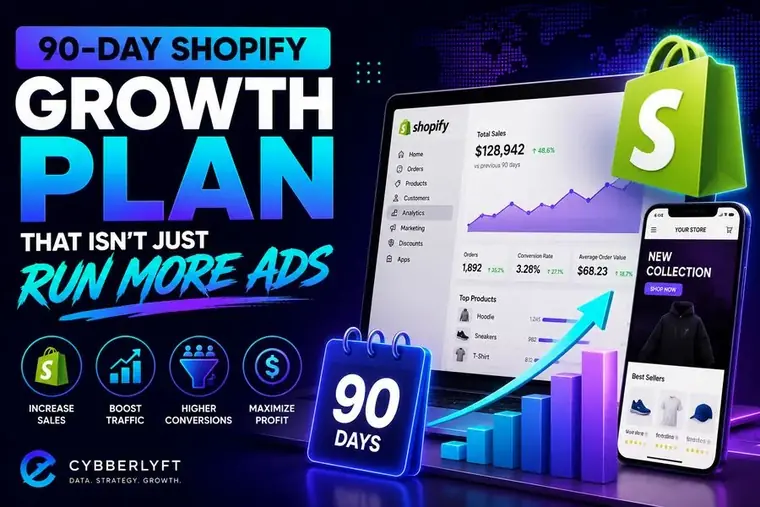
Ask most Shopify brands what their growth plan is and the answer, unprompted, is usually "spend more on ads." It works for a while — until it doesn't. Rising CPMs, ad fatigue, and platform changes eventually flatten the return on that approach, and brands that never built anything else are stuck.
A 90-day plan that actually compounds treats paid acquisition as one channel among several, sequenced deliberately rather than run in isolation from day one.
Why Ad-Only Growth Plans Stall
Paid acquisition has a structural ceiling: as you scale spend, you exhaust your best-fit audience and start paying more for lower-intent clicks. Without a retention engine (email/SMS flows) or organic channel (SEO, content) working in parallel, every dollar of growth requires proportionally more ad spend — margins compress, and the business becomes fragile to any single platform's algorithm changes.
Days 1-30: Fixing the Foundation
Before spending more on traffic, we fix what happens once traffic arrives. This phase focuses on:
- A full conversion audit of product pages and checkout, since even small friction points compound at scale.
- Rebuilding core Klaviyo flows — abandoned cart, browse abandonment, post-purchase — which for most stores we've audited are either missing or unchanged since setup.
- Cleaning up tracking and attribution so decisions in the next two phases are based on accurate data.
- A modest, controlled paid spend to keep learning signal flowing to ad platforms without over-committing budget to an unoptimized funnel.
Days 31-60: Layering in Organic and Retention
With the foundation fixed, this phase adds channels that compound rather than decay with spend:
- SEO content built around actual product-research queries, not generic blog topics.
- Expanding email/SMS beyond transactional flows into a regular campaign cadence tied to product launches and restocks.
- Testing creative formats (UGC, founder-led video) that typically outperform polished studio content on paid social.
- Scaling paid spend moderately, now that the funnel it's feeding converts meaningfully better.
Days 61-90: Scaling What Works
By this point there's enough data to see which channel combinations are actually driving profitable growth. This phase is about disciplined scaling rather than adding anything new: doubling down on the highest-LTV segments identified in paid, expanding the SEO content calendar around what's started ranking, and formalizing the retention calendar into a repeatable system the internal team can run without an agency doing every step.
A Sample Channel Budget Split
For a mid-size DTC brand starting this plan, a rough allocation we've used as a starting point: 55% paid media, 20% content/SEO, 15% retention/lifecycle, 10% creative production. This shifts over the 90 days as data comes in — it's a starting hypothesis, not a fixed rule.



Comments
Comments are currently disabled while we roll out our community guidelines. Have a question about this article? Reach out directly — we read every message.